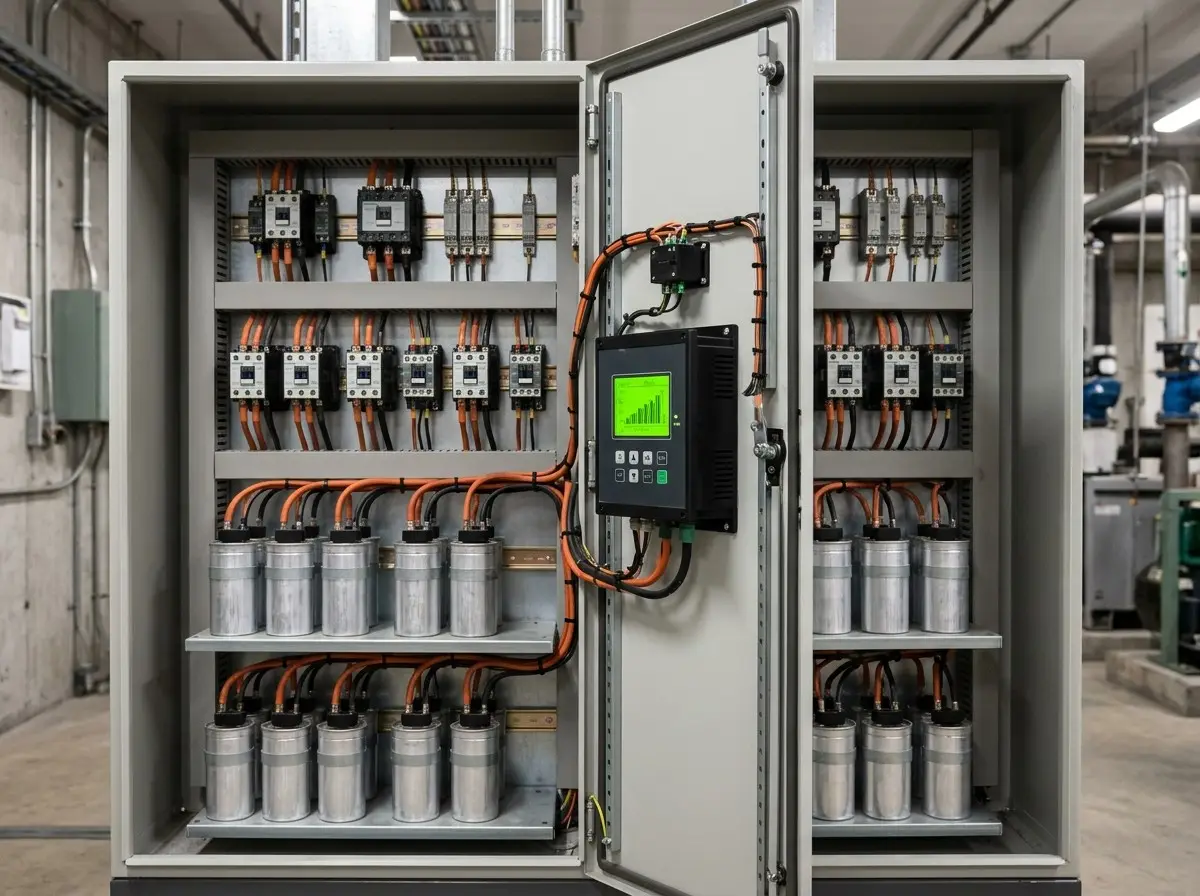
APFC panel and power factor: cut your bill
Motors, compressors and fluorescent drivers draw reactive power. That pushes your power factor down, raises current in every cable and can raise your bill. An APFC panel fixes it automatically.
Reading your bill
- Find the power factor (PF) figure for the month
- Look for kVArh (reactive energy) alongside kWh
- Check for any power factor charge or adjustment line
- Compare the maximum demand in kW and kVA
Why low power factor costs money
- More current for the same work, so more cable and transformer losses
- Higher kVA demand, which can force a bigger transformer
- Voltage drop at the far end of long feeders
- A possible charge under your utility's tariff
Penalty rules depend on your tariff. We check your actual bill and the current tariff before quoting any savings.
Sizing an APFC panel
The capacitor rating you need depends on your real load and how far you want to raise power factor:
kVAr = kW × (tan φ₁ − tan φ₂)
Example
A 200 kW load at power factor 0.75 raised to 0.95 needs about 200 × (0.882 − 0.329) ≈ 111 kVAr. We'd choose a panel with steps that add up to a bit more, for control.
Maintenance
Capacitors lose capacity over time and contactors wear. We check capacitor current, steps and the controller in every AMC visit.
Free site surveyFrequently asked questions
Why does my bill go up when power factor drops?
Low power factor means more current and more kVA for the same work. Depending on your tariff, there may also be a charge. We check your bill to see what applies to you.
What power factor should I aim for?
Most factories aim for close to unity without over-correcting. We size the panel for your real load profile.
How often should an APFC panel be checked?
At least at every maintenance visit. Capacitors lose capacity over time and contactors wear out.